Dying Embers out now

Dying Embers out now

Tuesday, 25 February 2014

Review: Ill at Ease 2

Ill At Ease 2 is, logically, the follow-up to Ill At Ease, a wonderful yet far-too-brief collection of three tales of urban unease. The original authors Mark West, Stephen Bacon and Neil Williams are joined this time by Shaun Hamilton, Robert Mammone, Val Walmsley and Sheri White for more of the same creeping horror.


Claire's awkward trip north in Pete's 'battered Ford Focus' turns into something more significant than could be expected in the cleverly-titled opening tale, Double Helix, by Stephen Bacon. The backgrounds of the protagonists are explored deftly, and a keen sense of anticipation is held right until the remarkably positive and thoughtful ending. This is a multi-layered, engaging story which sets the tone perfectly for the rest of the collection. Shaun Hamilton's The Shuttle follows up strongly, a powerful tale of relocation, and the dream of a new start in life. Paul and Sally are striving to become parents, and have exchanged their city pad for a family house in North Wales; but have yet to find out about the strange hold the quarry has over the local area. Suffice to say that, as a parent, Hamilton made it difficult for me to read some of this, but that's often the sign of a great horror story!

Masks, by Robert Mammone, deals with the aftermath of a disappearance. Harry is be the prime suspect after Emma, his partner, goes missing, and Detective Standish is determined to get his man. However, a blurred CCTV image of Emma leads to an obsessive search, and the tension is built up to a crescendo in the tunnels of Melbourne's underground train network. Edge-of-the-seat stuff, aided by a grittily authentic location. Next up, Val Walmsley subjects the reader to a severe case of schoolyard bullying in One Bad Turn; involving a haunted yew tree, and an unwittingly effective revenge. Be careful what you wish for, indeed! 

Mark West's contribution, The Bureau of Lost Children, must echo every parent's worst nightmare. Scott is left in charge of his young son Josh, temporarily abandoned by partner Jess in the Weston Centre, 'a new development dedicated to the worship of materialism on the outskirts of Chaton'. I recognise the sudden, empty realisation which strikes when a child goes missing, even for a moment; what West does is to follow this up with the awful details of what may happen next. The resulting nightmarish situation is enough to chill the blood, and the ending is like a blow. The Bureau of Lost Children is one of the highlights of this collection.

Speaking of nightmarish situations, Sheri White creates just that in Paradise Lost, a remarkably bleak, apocalyptic tale. Short and sharp, with a terrifying climax, it is sure to convince the reader to never again skimp on the holiday sunscreen! Finally, There Shall We Ever Be, by Neil Williams, finishes the proceedings strongly. Mark is returning home to Warrington to attend a funeral, and he chances upon an elderly companion, who alerts him to changes in the town and of how its past is being neglected. Surely all the ghosts and stories of years gone by have to end up somewhere? Mark discovers a nether world which mingles painfully with his own past, challenging him in ways he could never have guessed at. This is a gripping, tightly written tale with a great sense of location.

I thoroughly enjoyed Ill At Ease 2, and it turned out to be one of my reads of the year. The format works very well, the stories complement each other perfectly, and I very much look forward to Ill At Ease 3. My only humble suggestion would be to increase the number of tales once more!

Sunday, 23 February 2014

Women in Horror; this year's top 10

It's that wonderful time of the year again; Women in Horror Month. I enjoyed listing my top 10 short stories by female writers last year, so I thought I would update the list, one year on. These are stories not necessarily written during the year, but new to me during that time.


I have listed ten of my favourites from the year, and have added a few reviews. So, as usual in no particular order, here they are;

1. Collect Call, by Sarah Pinborough

2. Love, by Elizabeth Bowen

3. Mountain by Kaaron Warren, from Through Splintered Walls

4. Passing Forms, by Anne-Sylvie Salzman from Darkscapes

5. The Third Person, by Lisa Tuttle

6. These Things We Have Always Known, by Lynda E. Rucker from The Moon Will Look Strange

7. The Navigator, by Angela Slatter from Sourdough and Other stories

8. Rent Control, by Tracy L. Carbone from The Collection and other Dark Tales

9. Satan's Circus, by Lady Eleanor Smith form Satan's Circus

10. The Tale of Biddey Wiggin, by Margery Lawrence from The Floating Café and Other Weird Tales

So now onto some brief reviews.

Love, by Elizabeth Bowen
Elizabeth Bowen's short stories are succinct, acutely observed, dramatic; beautifully written, and as finely wrought as cut glass. More often than not, she is concerned with what lurks beneath the veneer of respectability. Love is a brief, little-known tale, from her collection Look at all those Roses (1941), and it captures the essence of her storytelling. The protagonist (we don't find out her name) is on a fortnight's holiday with Edna, a work colleague, at a seaside location. Their relationship is unsteady. 'If you asked me how I liked Edna I wouldn't know how to answer, but a girl on her own like I am has to put up with some things, and it's slow to go on your holiday all alone'.
They are walking along the rocky, rather remote coastline, their shoes weighed down with sand, when they stumble upon a narrow bay with a dilapidated hotel nestled against the cliffs, seemingly being swallowed up by the landscape. Despite everything, there is a faded board advertising tea, and Edna insists upon them partaking. As they look for the entrance, a woman in a bright blue dress appears, with words of warning; however, their knocks are answered by an unwelcoming youth, and they are soon being reluctantly served tea in the dark, shuttered-up hotel. The strange relationship between the youth and the woman in the blue dress becomes apparent, echoing the unstable situation of the building in the landscape; and of the intrusive cows, all around, reminding me of the bovine threat in Robert Aickman's Hand In Glove. There is a subtle sense of dread, and the reader is kept off-balance, still asking questions long after putting the book down.

These Things We Have Always Known, by Lynda E. Rucker
Things are different in Cold Rest, 'a hard town scratched out on the side of a Georgia mountain ridge, so far to the north it's bleeding over into North Carolina'. Neil is a sculptor, married to Sarah, a native of the town. The bizarre ideas for Neil's work come to him unbidden in his dreams, but at what cost? His brother Gary, an unsuccessful writer, comes to stay, hoping to tap into this strange source of inspiration, but he sees the warning signs and gets away; as does Emma, Neil and Sarah's teenaged daughter. Lynda E. Rucker's sparse, telling prose pushes this bleak tale to its conclusion, where Neil is finally left alone in Cold Rest. 'A little while ago there was a splitting sound, and I heard things scuttling then swarming the sides of the house; it is only a matter of time before what is out there gets in.' The Things We Have Always Known is a haunting tale of the strength of family ties, the power of place, and the misunderstanding which comes from things unspoken. As with all of this author's work, it begs to be re-read many times. My advice to you would be to get a copy of The Moon Will Look Strange right now, if you haven't done so already.

The Navigator, by Angela Slatter
In her short story collection Sourdough and Other Stories, Angela Slatter has created a multi-faceted world of fairy tale, allegory and exquisitely powerful horror. The Navigator, a poignant tale, features the tense relationship between Windeyer, a part-avian, part-human creature, and the protagonist. Betrayal from the past has caused Windeyer to have been cruelly clipped of his wings, and a simmering atmosphere of resentment propels the tale. Bitter memories are never far from the surface, and love is combined with retribution in its tragic yet poetical ending. To me, this author has the unique ability to move a story to its conclusion, yet simultaneously to transfix the reader in a moment of time; with all that entails. Magical.

Sunday, 16 February 2014

Review: In a Season of Dead Weather, by Mark Fuller Dillon

In a Season of Dead Weather is a collection of seven short stories by Canadian author Mark Fuller Dillon. It consists of an authentically strange world of the author's own design, into which the reader is cast adrift; duly I found myself lost, and happily so.

https://www.smashwords.com/books/view/287841

This reader willingly joined the protagonist of Lamia Dance, the book's opening tale, by stepping out of the wind into the 'grimy, dark-paneled lobby of the cinema', and was captured straight away. In this powerfully poetic piece, an introverted youth attempts to socialise by viewing what turns out to be an obscure and erotic film with his fellow students, but is so disturbed by the experience that his isolation is thrown into even starker relief. As his past unravels itself on the screen before his eyes, he can take no more, and leaves before the main feature; but is his departure from the cinema too early, or too late? The tone is set.

Next is Never Noticed, Never There which deals with people's misguided perception of reality. Disappearance follows disappearance, then graphic designer Tom Lighden begins to see ghosts everywhere; his search for the missing Robert Piedmont leads him to an alternative world, partly within the very substance of things. The world reclaims him, but it keeps on turning regardless, and sure enough, no one notices.

Winter's approach looms large over Shadows in the Sunrise, which is set shortly into the future, after some kind of economic or social meltdown. Most have left the farmland for the apparent safety of walled cities, leaving our protagonist as some kind of caretaker, abandoned and alone, fearing the onset of the season's harsh weather. He visits a farmhouse full of recollections from his youth; but are those memories authentic, or do the shadows on the wall and the lights in the sky exist only in his mind? We begin to question the validity of his viewpoint as his isolation becomes ever more complete.

When the Echo Hates the Voice is the intriguing tale of Marcel Dumont, an obstetrician who makes his very first (and successful) delivery, then abruptly experiences a frightening hallucination. The resulting child, Paul Bertrand, grows up to be a popular, yet highly strung youth: convinced he is being somehow persecuted. He seems to have every advantage in life, but is there a side of him which is determined to destroy it all, through an insanely jealous rage?

In What Would Remain? Colleen is a political activist, recently released from jail, who struggles to contact her mother at her isolated home. Eventually, and with the prospect of worsening weather, she drives out to investigate; she finds a desolate landscape in the grip of a blizzard, inhabited only by ghosts. Having found her mother at last, she struggles to prevent her from joining the constant flow of people trudging past her house, to the north and to their certain doom in the snowy landscape. The question is posed: if the world was purged of humanity, what would remain?

Mikhail remembers the 'tall blind houses near the canal' in The Weight of its Awareness, perhaps my favourite story of this collection. Now middle-aged, the possibilities of youth long gone, he is determined to capture even a fleeting glance of what might have been; so he sets out on a journey one morning to find those houses once more. However, his unreliable memory is unable to prepare him either for what he finds or for what he has unwittingly become.

Finally, The Vast Impatience of the Night introduces us to the numerous widows of a small rural community. Janet Richardson makes her way home one evening after yet another bereavement, and encounters a barricade of cloud, ghostly figures, and a bizarre light show. In her quest for safety, and to 'look after her girls', does she stumble upon all that remains of the widowers themselves? The thought of history repeating itself is almost too much for her to bear.

There are themes of love and loss, misunderstanding, and a diminishing sense of identity throughout this collection which link the stories strongly. The bleak landscape clearly inspires the author, and his descriptive prose of rural communities in the grip of a Canadian winter will have you shivering; yet despite this there is a warmth of experience here which brings the characters to life, proving the author not only writes beautifully, but also has a lot to say.

I was entranced by this book, and I read it in one sitting. These are powerful yet subtle three-dimensional tales from an original mind, and Mark Fuller Dillon deserves a greater readership; which I'm sure will come his way soon.

Monday, 10 February 2014

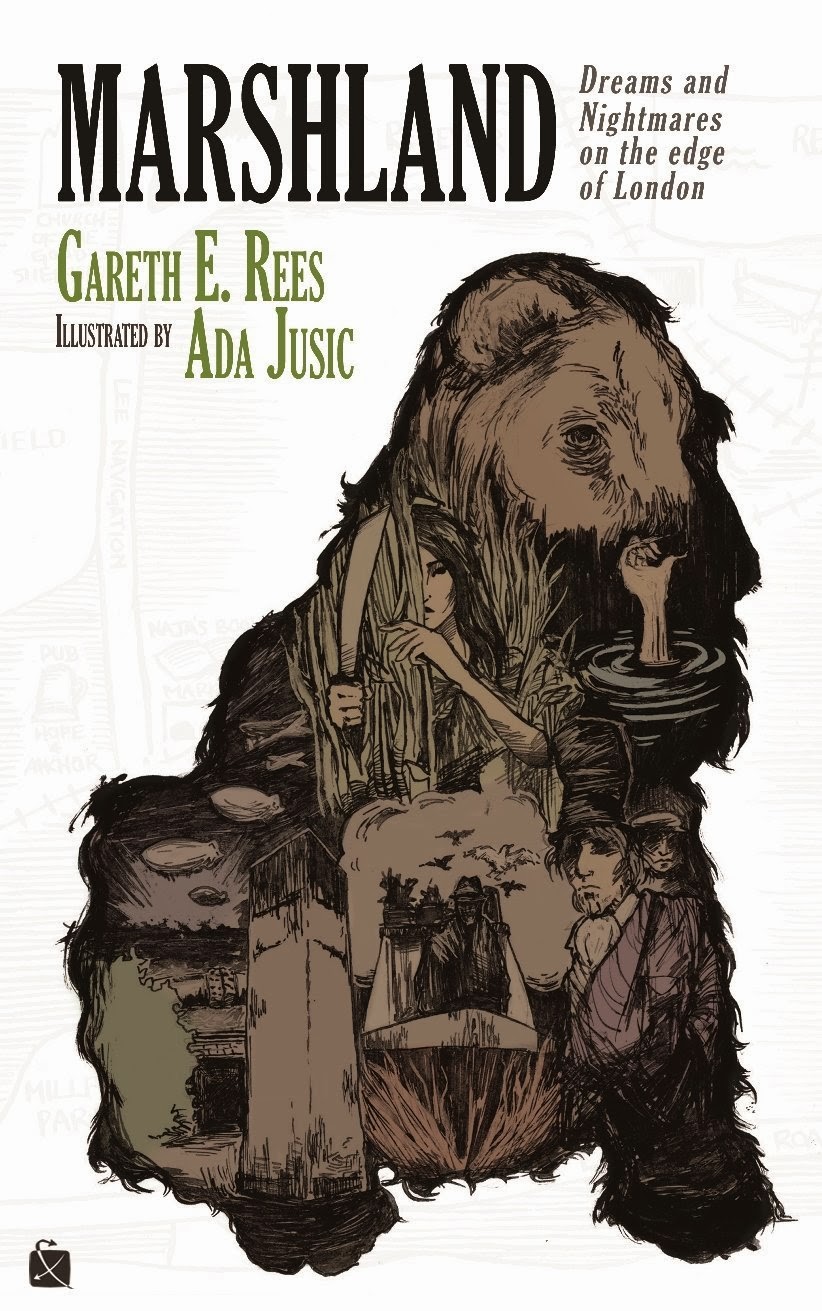
Review: Marshland, by Gareth E. Rees

This book, written by Gareth E. Rees and illustrated by Ada Jusic, surprised me greatly. I was initially interested in it because, on the surface, it tells stories of and about the area around the Lea basin; and I grew up a short walk from the River Lea. I was therefore looking to reminisce, perhaps to learn a little more of the area's history.

However, Marshland, Dreams and Nightmares on the Edge of London is so much more than that.


I was not prepared for its broad scope. Part memoir, part historical document, part political commentary, part strange story collection... it works on so many levels. It even has a humorous aspect, with a very funny sequence involving social media, which made me laugh out loud. Although it's all of these things and more, Rees has pulled it all together remarkably well, and it is a thoroughly satisfying read.

Our protagonist wanders the Hackney marshes and the banks of the River Lea with his dog Hendrix. He reflects upon his life, the geography of the area, its history, and his own imagination. In this unique landscape he muses over the legacy of the London Olympics, the inland waterways, the disused filter beds, the fascinating story of Whipple and Hazlehurst, and much more. The reader is taken on a number of journeys where the past meets the present; and where they collide, ghosts are encountered and strangeness abounds.

These ghosts initially take the form of engineers from the Victorian era, haplessly time-travelling and way out of their depth, in The Most Peculiar Vanishing of Messrs Whipple & Hazlehurst. Rees expertly uses these characters from history to highlight the changes in the area both physically and socially. In The Ghost Factory, occupants of a trendy development built on the marshes find themselves transforming into the workers from a demolished factory. Marsh Meat sees Albie meeting a bear... but does the bear meet Albie? Of particular interest to me are the ongoing sightings of creatures in and on the banks of the Lea, as these reports formed part of my own childhood. We even visit the area as post-apocalyptic landscape in Naja's Ark, a fascinating prediction of the near-future; and in Endgames, the switch to the Gregorian calendar is pondered: 'The day Parliament stole time, things began to go wrong on the marshes.'

The illustrations work very well, even in the Kindle version which I purchased, adding another dimension to the book. Indeed, included is The Raving Dead, a stand-alone graphic tale involving zombies rising up from the Lea and haunting the marshes. What more could you want?

Marshland will make you look at your own environment in a different light. It combines fact with fiction, history with horror, temples with time travel. Rich pickings! I enjoyed the ride and I can't wait to read more from Gareth E. Rees.

Wednesday, 29 January 2014

Review: Little Visible Delight, by S.P. Miskowski & Kate Jonez

Obsession
1. An idea or image that repeatedly intrudes upon the mind of a person against his will and is usually distressing.
2. The action of any influence, notion, or 'fixed idea', which persistently assails or vexes, esp. so as to decompose the mind.
3. The hostile action of the devil or an evil spirit besetting any one; actuation by the devil or an evil spirit from without; the fact of being thus beset or actuated.


When I found out that Little Visible Delight, the anthology of dark fiction by S.P. Miskowski and Kate Jonez, was themed along the lines of 'obsession', I felt compelled to get out my copy of the Compact Oxford English Dictionary. Each definition seemed scarier than the one before. It was a good omen.

There's nothing quite as inviting as a collection of dark fiction, especially with every story being new to me; and every page of this publication is to be savoured, consisting of edgy, unnerving tales of subtle strangeness. Proceedings kick off with The Receiver of Tales, by Lynda E. Rucker, in which Aisha recalls her intimacy with Ruben, and of how he had been usurped by people's stories; and of how it ruined him. Has this curse been transferred to her? It seems so, as she carves precious words all over her body. Is she stronger than he, or will she take the easy way out? She embarks upon a dreamlike journey, and at its conclusion, Aisha realises she cannot live without the very obsession she railed against.

Preoccupation with the fountain of youth and the ruthless pursuit of immortality is tackled in the complex Needs Must When the Devil Drives, by Cory J. Herndon. It seems we must be careful what we wish for, and be grateful for being a long time dead! Next up Kate Jonez provides A Thousand Stitches. Laura Beatty finds herself at Malley's Dry Cleaners, a down-at-heel establishment which she hopes is a stepping-stone to the exciting life just around the corner in New York. She repairs wedding dresses with Judy, a worker who seemingly has a murky past with the firm. When conditions and pay are changed for the worse, Laura Beatty faces the fact she may never be able to achieve her dream of escape; yet a chance is given and taken both immediately and gratefully. Once she is safely in New York, however, the reader has cause to question both her motives, her methods and even her identity.

Johhny Worthen's intriguing tale The Point, set in the dark bunker of the mind, tackles death and Armageddon, leading on to Calligraphy, by James Everington. Blake rises one morning, not as a beetle, nor even to be arrested, but to find 'elegant, cursive writing' all over his face. He is, however, unable to decipher the meaning of the words. Forced to forsake his preferred seclusion in order to seek some kind of explanation, a neighbour leads him to an unfamiliar church, in what has become an unfamiliar world; in front of the congregation, the priest reads the words on his face. Does this bring enlightenment, or just the opposite? A typically compelling story by this author.

This Many, by S.P. Miskowski, explores the world of the competitive parent. Stay-at-home mother Lorrie dreams of the perfect fairy dress for her daughter Frances, and forces her to don it for her birthday party: '"Mom made it so I have to wear it," Frances said, and rolled her eyes.' During this extravaganza, an extra adult appears and causes much confusion after disappearing somewhere within the house. A search reveals nothing, but the contact between the sinister intruder and Frances has caused something to change, so that next year's party may not be looked forward to quite so enthusiastically... Miskowski deftly exposes the cracks present behind the facade of the perfect family, leaving the reader to wait for the inevitable collapse.  

JP, by Brent Michael Kelley, explores a child's seemingly innocent obsession with a pet which has died; and of how a strong desire not to be separated ends in something gruesome. Deceptively simple, this story is not for the fainthearted, and is as close to conventional 'horror' as this collection gets. Black Eyes Broken, by Mercedes Yardley, is the sad tale of Natalia, who has the unfortunate knack of destroying everything she loves. Her relationships inevitably end in tragedy, and this leads to her withdrawal from the world. Worse is to come, however, as she thinks of the future.

This fine anthology is topped off by Bears: a Fairy Tale of 1958, by Steve Duffy. This is a finely-wrought take on Goldilocks and the Three Bears, documenting the Bear family's attempt to assimilate into late-1950s society, but suffering from discrimination, heartache and practical problems at every turn. Tongue-in-cheek it may be but it still packs a satisfying punch.

There is not a weak story here; and, add to this the excellent design and presentation of the Kindle version I bought, means I would recommend this wonderful collection to anyone who enjoys short stories.

Sunday, 19 January 2014

Dying Embers available for pre-order

I'm very pleased to announce that Dying Embers, my first collection of strange adventures, is now available for pre-order direct from Satalyte Publishing. All you have to do is send an e-mail to sales@satalyte.com.au with your request and there you go! It will give them an idea of the demand in advance of publication... and you'll be first in the queue.


“My mind had created a monster in the next terrace…”


Welcome to the world hidden behind the everyday. These stories of urban strangeness explore what goes on within the dying embers of the fire, once the heat has almost gone.

An historic building holds the key to a terrible secret from Letherby's youth. A passenger on an international flight finds out that he is not master of his own destiny – finding out who is, though, is quite another matter. Rural Australia proves less welcoming than Preston had hoped, forcing him to confront the guilt from his past. Pocock witnesses something calamitous on the river bank which changes the course of his life. The alien landscape of a network of warehouses provides the background to a remarkable transformation. An ill-fated property search leads first to admission, then to a strange form of retribution, and ultimately to a terrifying reunion.

“A fascinating and eclectic collection of strange adventures…”
James Everington, author of Falling Over.

“These are powerful, energetically written tales that are some of the finest I’ve read in the genre of dark fiction. The language is wonderfully imaginative and instantly thrusts the reader into the realms of slowly revealed decay. A must-read!”
Paul Hodge, Freaky Folk Tales


Check out the full list of books coming up from Satalyte here. Many genres are represented, so there is bound to be something for everyone. By the way, the website for Dying Embers is at martincosby.com so have a look if you like. I will let you all know as soon as I have a publication date.

Monday, 6 January 2014

Farewell Elizabeth Jane Howard

I was born in Kensington. My father was a composer. My mother came from a rich home, and was, I believe, incurably romantic. She married my father, despite the half-hearted protestations of her family, who felt that to marry a musician was very nearly as bad as to marry into trade, and much less secure.

My old copy of The Beautiful Visit (1950), Howard's first novel
So begins chapter one of The Beautiful Visit, Elizabeth Jane Howard's first novel, and the first example of her writing I had encountered; many years ago. It soon became one of my favourite novels. Enchanting, sensitive and beautifully written, it tells of a magical experience in a young girl's life, the mood of which can never be regained. Despite the delicate, elegant prose, it is also powerful, quite an achievement for a writer so young (she was in her twenties at the time). The book is dedicated 'To Robert Aickman', and it was some time before I noticed this, linking it to the author of Ringing the Changes and The Hospice I had enjoyed many more years previously. Intrigued, I bought a copy of her excellent autobiography Slipstream, and I began to discover what a strange relationship the two had. As my interest in Aickman deepened, it became clear how much she may have affected his writing.

Slipstream, her excellent autobiography
The Beautiful Visit displays a sense of mystery, a lightness of touch – even, yes, of strangeness – which could in fact have influenced Aickman. They first met when she approached him with the complete manuscript of The Beautiful Visit as he was at the time a literary agent, and an experienced writer, though only in journals and of reviews. He advised her and helped her revise her work, and was influential in getting it published. It was an immediate success, winning the John Llewellyn Rhys Memorial Prize and selling well.

The Tartarus edition of Three Miles Up, Howard's own collection of strange stories
It was only after this that Aickman began writing his own fiction. I've heard suggested that he was rather jealous of Howard's admiration of L.T.C. Rolt's supernatural stories, therefore setting out to outdo his fellow Inland Waterways founder by penning his own. (If this is true, in the long term he was certainly successful; however, Sleep No More, Rolt's collection of short stories, is well worth reading in its own right.) His problems began when he struggled to get his own stories published. It was perhaps a blow to his ego when he could only achieve this by a joint venture with Howard, insisted upon by the publisher to ensure sales; which became We Are For the Dark. Certainly Three Miles Up, one of Howard's three stories in the collection, could be said to be Aickmanesque; however, it was written before such a term could be applied. It's certainly one of the most finely-wrought and enigmatic of short stories. Howard of course went on to achieve the kind of critical and commercial success Aickman could only dream of, and indeed he went searching for something similar by dallying with the American market later in life. He barely succeeded (his works were rarely reprinted, and his stature has grown, in the main, since his death). Howard was to spurn him; yet Aickman's fondness for her continued throughout his life. He even asked to see her on his death bed, a request which it is said she declined.

I had a dream some years ago that I bumped into the ageing but still beautiful Elizabeth Jane Howard at a party, and she shared with me and me alone some confidential snippets about her tempestuous relationship with Robert Aickman so many years before. Until a few days ago, I was hopeful this unlikely event may somehow occur.

Farewell Elizabeth Jane Howard.