Dying Embers out now

Dying Embers out now

Thursday, 23 May 2013

Perfect penny dreadfuls

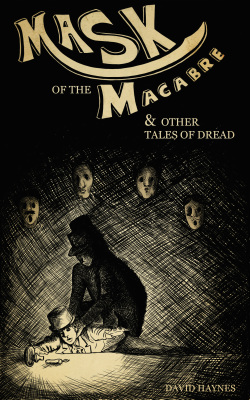
I've been immersed (or should I say shrouded) in Victorian gothic recently. I was tempted to try Mask of the Macabre, a collection of four short stories by David Haynes, and became hooked. This led me to his second collection of tales, Ballet of the Bones. Just as I was regaining my breath from that one, I found out there was a novella called Seance of the Souls. I must point out that the author has done a very clever thing; it is quite possible to enjoy any of these books individually, in any order ... yet taken together, and in sequence, they tell a story which will keep you on the edge of your reading chair (perhaps your mind?) until the very last page.


Mask of the Macabre sets the scene for your journey to the sordidly time-worn and foggy streets of Victorian London. You will soon wonder at the magician's grisly sleight of hand, and be shocked by the change of scene taking you within the walls of the Bethlem lunatic asylum. Then, the photographer's hideous job will make you wonder at the evil within human nature; depositing you, finally, with the entertainer – looking to expand his gruesome repertoire. If you are not too shell-shocked by now, you are welcome to experience ...


... the Ballet of the Bones! Will you appreciate the hideous displays in The Gallery of Wax? If so, you will be ushered into The Bone House, to experience first hand the bare bones of the gravedigger's existence. You will then meet The Engineer, who will astound you with his baroque, intricate creations, operating with the strange grace of precision; yet somehow quite wrong. And finally, with an impending sense of doom, the Director will prepare you for the final curtain. Good luck!


Perhaps, though, you may not be able to make your escape quite yet. You will be drawn, almost against your will, into the swirling, misty alleyways of the past once more, to experience the Seance of the Souls. With a growing sense of unease, you'll recognise some of the hideous characters from your previous travails.


Beginning with a funeral where Matthew Napier is confronting the loss of his family, you will stumble through bloodstained gutters once more to witness a fortune teller giving him and his sister a bleak reading indeed. Once Matthew's sister is ripped from him too, his despair is complete; and he is vulnerable to the advances of pure evil. This is embodied by members of a spiritualist church, and he is confronted by the past in ways even you, dear reader, could not imagine. Is it magic, or murder? Who can Matthew trust? Amid corpses, skulls and ever-shifting masks, you will not know which way to turn. Be sure to keep your own senses sharp as those around you descend into madness!

Friday, 17 May 2013

Mask of the Macabre and Ballet of the Bones

I have just discovered the work of David Haynes, and have thoroughly enjoyed his two collections of short stories, Mask of the Macabre and Ballet of the Bones.
Firstly I must say I was tempted to try them due to their excellent, quirky covers. As a graphic designer myself, I appreciate the visual side of the equation when it comes to publishing, and these really stand out. Not only are they that bit different, but they suit very well the content and style of the books.


As for the tales themselves, well, I may very well do a review soon (and also of his new novella, Seance of the Souls), but in the meantime I hope Mr Haynes would not mind me reproducing the blurb he has provided on his website:

Mask of the Macabre
Four short tales of Victorian terror, each bound to the other by a chilling  thread. The date is January 10th 1866 and the snow is falling thick on  the blood soaked streets of a murderous London…
Mask of The Macabre: A travelling magician appears with a gruesome show. But what secret does it  hide?
Doctor Harvey: Bethlem lunatic asylum’s newest patient has a story to tell, but how will he tell it to his doctor?
Memento Mori: A photographer is given a mysterious assignment with disturbing consequences.
The New Costume: The entertainer discovers a new string to his bow and gives the finest performance of his career.


Ballet of the Bones
Four short tales of Victorian terror, each bound to the other by a chilling thread. London suffocates under the festering reek of its bursting graveyards.
Ballet of the Bones
: The curtain goes up on the greatest show on earth, but is everything all it seems?
The Bone House
: The grave digger reflects on his morbid life, but what does his future hold?
The Engineer: His creations are beautiful, intricate and for a discerning  palate.
Encore
: The director makes ready for the end of the show.

Sunday, 5 May 2013

Childhood influences and burial sites

One of the main influences for my writing thus far has been my childhood. I recently had the opportunity to revisit the playgrounds of my youth; and, perhaps inevitably, I was taken aback by how different they seemed. 
I set out for a run from my childhood home, across the playing fields and through the Spinney I wrote about in The Source of the Lea and Abraham's Bosom, and on to the Marsh House playgrounds. There used to be an enormous children's adventure area styled after a fort, which was impossibly exciting to me as a child, and now it has become a BMX track. Marsh House still stands alongside, but it's a sad sight now, doors and windows boarded or bricked up. I recall the side of the building being painted in bright colours, back in 1978, when it was transformed into a youth centre. At that time there was a go-kart track there, on some old tennis courts, delineated by piles of car tyres. It was a mecca for youngsters back then, but now it is mainly deserted. It occurred to me that there could be some inspiration for a story here, so I thought I'd take some photos.

This is the painted side of Marsh House, which now looks to be deserted and boarded up
The front of Marsh House
All the ground floor windows are either boarded or bricked up.
I wonder what's inside
This made me think about creepy stories suggesting childhood memories, of which there must be quite a few. Two such tales by Aickman spring to mind, The Same Dog and The Inner Room. The interesting thing to me about using a child (or a younger version of the writer) as the main protagonist is that misunderstandings can be created; the child's view of things can be unreliable, which adds to the mystery. One of my favourite stories along these lines must be The Shelter by James Everington. This is a particularly evocative tale of the vagaries involved in the formative years. The Boy in Green Velvet or Come into My Parlour by Reggie Oliver might fit the bill too.


While I was wandering around reminiscing, I was reminded that the surrounding area, Waulud's Bank, is named after a neolithic burial site. A D-shaped enclosure, it takes the form of a grassy bank through the surrounding woods, down which we used to run, roll, cycle, toboggan ... depending on the weather. I've since found out that a major ley line runs through the middle of the site, stretching from Cornwall to Yarmouth; it also bisects the Avebury stone circles. Apparently there would once have been stones at Waulud's Bank too, but they have long since disappeared. We used to find arrow heads, bits of pottery and so on in the chalky soil there, but we thought nothing of it. In recent years, many very significant finds have taken place there, but with almost no publicity. I could only find one scruffy old sign mentioning anything about it; but I'm sure more people would be interested if the history was more widely known.
I'm also sure there's a story in there somewhere ... History can make for a compelling tale, adding a convincing background to a good story, particularly when ghosts are involved. For proof, have a look at the excellent blog Freaky folk tales, for some evocative MR James-esque delights.

Part of the ancient Waulud's Bank in the foreground, and the three blocks
of flats over the hill. Five Springs is the closer of them 
The only sign I could find with details of this fascinating area

Friday, 3 May 2013

Hitcher and Those bastards in their mansions

I have posted a couple of very well known Simon Armitage poems today; Hitcher and Those bastards in their mansions (both from Book of Matches). Not ghostly, but certainly horrific in a mundane, matter-of-fact way; which is something I strive to achieve in my writing. 


Hitcher must be Armitage's most famous poem. It is simple yet ambiguous; is it a straightforward monologue, or is the speaker remembering himself as he was before being enslaved into working life? The casual violence of it is shockingly effective. 

Hitcher
by Simon Armitage

I'd been tired, under
the weather, but the ansaphone kept screaming.
One more sick-note, mister, and you're finished. Fired.
I thumbed a lift to where the car was parked.
A Vauxhall Astra. It was hired.

I picked him up in Leeds.
He was following the sun to west from east
with just a toothbrush and the good earth for a bed. The truth,
he said, was blowin' in the wind,
or round the next bend.

I let him have it
on the top road out of Harrogate – once
with the head, then six times with the krooklok
in the face – and didn't even swerve.

I dropped it into third
and leant across
to let him out, and saw him in the mirror
bouncing off the kerb, then disappearing down the verge.
We were the same age, give or take a week.
He'd said he liked the breeze

to run its fingers
through his hair. It was twelve noon.
The outlook for the day was moderate to fair.
Stitch that, I remember thinking,
you can walk from there.


Those bastards in their mansions could be seen as a powerful call to arms for the populace. It would seem that the privileged should not persist with complacency; instead they should look out for one who sticks to shadows and carries a gun!

Those bastards in their mansions
by Simon Armitage

Those bastards in their mansions:
to hear them shriek, you'd think 
I'd poisoned the dogs and vaulted the ditches, 
crossed the lawns in stocking feet and threadbare britches, 
forced the door of one of the porches, and lifted 
the gift of fire from the burning torches,

then given heat and light to streets and houses, 
told the people how to ditch their cuffs and shackles, 
armed them with the iron from their wrists and ankles.

Those lords and ladies in their palaces and castles, 
they'd have me sniffed out by their beagles, 
picked at by their eagles, pinned down, grilled 
beneath the sun,  

Me, I stick to the shadows, carry a gun

Thursday, 25 April 2013

Our Little Ghost and The Telegraph Operator

The first of my spooky poems today is Our Little Ghost by Louisa May Alcott. She was better known for her novel Little Women (1865) which was one of the first novels of the Literary Realism movement, and she was an active feminist. Our Little Ghost is a very sad poem, but it reflects the fact that in the mid-nineteenth century around half of the children from poor families died in childhood ... so there were many Little Ghosts.

Our Little Ghost
Louisa May Alcott

Oft in the silence of the night,
When the lonely moon rides high,
When wintry winds are whistling,
And we hear the owl's shrill cry,
In the quiet, dusky chamber,
By the flickering firelight,
Rising up between two sleepers,
Comes a spirit all in white.

A winsome little ghost it is,
Rosy-cheeked, and bright of eye;
With yellow curls all breaking loose
From the small cap pushed awry.
Up it climbs among the pillows,
For the 'big dark' brings no dread,
And a baby's boundless fancy
Makes a kingdom of a bed.

A fearless little ghost it is;
Safe the night seems as the day;
The moon is but a gentle face,
And the sighing winds are gay.
The solitude is full of friends,
And the hour brings no regrets;
For, in this happy little soul,
Shines a sun that never sets.

A merry little ghost it is,
Dancing gayly by itself,
On the flowery counterpane,
Like a tricksy household elf;
Nodding to the fitful shadows,
As they flicker on the wall;
Talking to familiar pictures,
Mimicking the owl's shrill call.

A thoughtful little ghost if is;
And, when lonely gambols tire,
With chubby hands on chubby knees,
It sits winking at the fire.
Fancies innocent and lovely
Shine before those baby-eyes,
Endless fields of dandelions,
Brooks, and birds, and butterflies.

A loving little ghost it is:
When crept into its nest,
Its hand on father's shoulder laid,
Its head on mother's breast,
It watches each familiar face,
With a tranquil, trusting eye;
And, like a sleepy little bird,
Sings its own soft lullaby.

Then those who feigned to sleep before,
Lest baby play till dawn,
Wake and watch their folded flower
Little rose without a thorn.
And, in the silence of the night,
The hearts that love it most
Pray tenderly above its sleep,
'God bless our little ghost!'


Next we have a change of pace, and Robert W. Service's The Telegraph Operator, an atmospheric piece about loneliness with I think something of the taste of The Signalman by Dickens.

The Telegraph Operator
Robert W. Service

I will not wash my face;
      I will not brush my hair;
I "pig" around the place —
      There's nobody to care.
Nothing but rock and tree;
      Nothing but wood and stone;
Oh God, it's hell to be
      Alone, alone, alone.

Snow-peaks and deep-gashed draws
      Corral me in a ring.
I feel as if I was
      The only living thing
On all this blighted earth;
      And so I frowst and shrink,
And crouching by my hearth,
      I hear the thoughts I think.

I think of all I miss —
      The boys I used to know;
The girls I used to kiss;
      The coin I used to blow:
The bars I used to haunt;
      The racket and the row;
The beers I didn't want
      (I wish I had 'em now).

Day after day the same,
      Only a little worse;
No one to grouch or blame —
      Oh, for a loving curse!
Oh, in the night I fear,
      Haunted by nameless things,
Just for a voice to cheer,
      Just for a hand that clings!

Faintly as from a star
      Voices come o'er the line;
Voices of ghosts afar,
      Not in this world of mine.
Lives in whose loom I grope;
      Words in whose weft I hear
Eager the thrill of hope,
      Awful the chill of fear.

I'm thinking out aloud;
      I reckon that is bad;
(The snow is like a shroud) —
      Maybe I'm going mad.
Say! wouldn't that be tough?
      This awful hush that hugs
And chokes one is enough
      To make a man go "bugs".

There's not a thing to do;
      I cannot sleep at night;
No wonder I'm so blue;
      Oh, for a friendly fight!
The din and rush of strife;
      A music-hall aglow;
A crowd, a city, life —
      Dear God, I miss it so!

Here, you have moped enough!
      Brace up and play the game!
But say, it's awful tough —
      Day after day the same
(I've said that twice, I bet).
      Well, there's not much to say.
I wish I had a pet,
      Or something I could play.

Cheer up! don't get so glum
      And sick of everything;
The worst is yet to come;
      God help you till the Spring.
God shield you from the Fear;
      Teach you to laugh, not moan.
Ha! ha! it sounds so queer —
      Alone, alone, alone.

Friday, 12 April 2013

Darker Times Vol 3 and a review

 
My short story Abraham's Bosom is now available in the Darker Times Anthology Vol 3.
E-book now, and paperback soon. Details here:
http://www.amazon.co.uk/Darker-Times-Anthology-Volume-ebook/dp/B00CBNQOPO/ref=sr_1_3?s=digital-text&ie=UTF8&qid=1365752999&sr=1-3&keywords=darker+times+anthology
Or in the US:
http://www.amazon.com/Darker-Times-Anthology-Volume-ebook/dp/B00CBNQOPO/ref=sr_1_3?ie=UTF8&qid=1365753031&sr=8-3&keywords=darker+times+anthology


Review of Love and Loyalty by Maria Savva


My preferred form of writing is the short story, but usually of the darker kind; so I did not know what to expect of Maria Savva's collection, Love and Loyalty. I was pleased to find myself hooked from the beginning of the first story, The Artist. Jane is trying to talk the artist, Franco, out of suicide; but has she already missed her chance? She begins to doubt herself, and indeed her own sense of reality. This is a good introduction to the book, introducing Savva's careful characterisations and story telling skills. One Thing Leads to Another is a cautionary tale of the damaging domino effects possible by being just a bit too true to yourself. This is followed by I'm Only Doing My Job, which attempts to explain the strange behaviour of some traffic wardens...
Mannequin shapes like it could easily be a supernatural tale, then changes its direction abruptly, which quite caught me out. Friendship is the key! The same could be said of My Darkest Day, which manipulates mood to good effect. I never knew what 'atychiphobia' meant, but after this story of the same name, I'm unlikely to forget. I'm sure Vivienne would either have known, or would at least look it up straight away! She is the kind of character who always gets her comeuppance... but does she? As with most of these stories, you'll be left thinking. The Perfect Life deals with misunderstanding and deception in the workplace, and will surprise you at its conclusion.
Perhaps my favourite is Ordinary Lives, which is another cautionary tale involving the intellectual property of a novel... just when can it be claimed as one's own? Friendships are at stake. This story unfolded gradually, and surely every aspiring writer could relate to it. The collection ends strongly with Speed King, plotting the gradual divergence of an older couple, via fast cars and the internet, and finally Out of the cauldron, Into the Fire, which will discourage you from crying wolf once and for all.
I enjoyed these carefully plotted stories with their contemporary settings, thoughtful endings and realistic characters. I am looking forward to Maria Savva's next collection.

Wednesday, 3 April 2013

Acquainted With the Night

A few more of my favourite poems for your enjoyment today. I have been busy editing and re-writing stories for my upcoming collection, (probably) called Dying Embers. It's still some way off, and it means I don't have so much time for the blog right now.


Acquainted With The Night is one of Robert Frost's lesser-known poems, but it has an elegance and simplicity that appeals to me; and a certain mystery. What exactly does 'I have been one acquainted with the night' mean?

Acquainted With The Night
by Robert Frost

I have been one acquainted with the night.
I have walked out in rain—and back in rain.
I have outwalked the furthest city light.

I have looked down the saddest city lane.
I have passed by the watchman on his beat
And dropped my eyes, unwilling to explain.

I have stood still and stopped the sound of feet
When far away an interrupted cry
Came over houses from another street,

But not to call me back or say good-by;
And further still at an unearthly height,
One luminary clock against the sky

Proclaimed the time was neither wrong nor right.
I have been one acquainted with the night.

Resumé is Dorothy Parker's best-known poem, and it is rather brittle, perhaps in a similar style to her short stories. It's light-hearted on the surface, but conceals an undercurrent of darkness.

Resumé
by Dorothy Parker

Razors pain you;
Rivers are damp;
Acids stain you;
And drugs cause cramp.
Guns aren't lawful;
Nooses give;
Gas smells awful;
You might as well live.


Finally, Ozymandias by Shelley, surely one of the most powerful and influential of sonnets. It's interesting how the words of the poet have long outlasted the monument he wrote about (although Shelley apparently never saw the statue of Rameses II – aka Ozymandias) as it does not survive.


Ozymandias
by Percy Bysshe Shelley

I met a traveller from an antique land
Who said: Two vast and trunkless legs of stone
Stand in the desert. Near them, on the sand,
Half sunk, a shattered visage lies, whose frown,
And wrinkled lip, and sneer of cold command,
Tell that its sculptor well those passions read
Which yet survive, stamped on these lifeless things,
The hand that mocked them, and the heart that fed;
And on the pedestal these words appear:
"My name is Ozymandias, king of kings:
Look on my works, ye Mighty, and despair!"
Nothing beside remains. Round the decay
Of that colossal wreck, boundless and bare
The lone and level sands stretch far away.