Dying Embers out now

Dying Embers out now

Monday, 10 February 2014

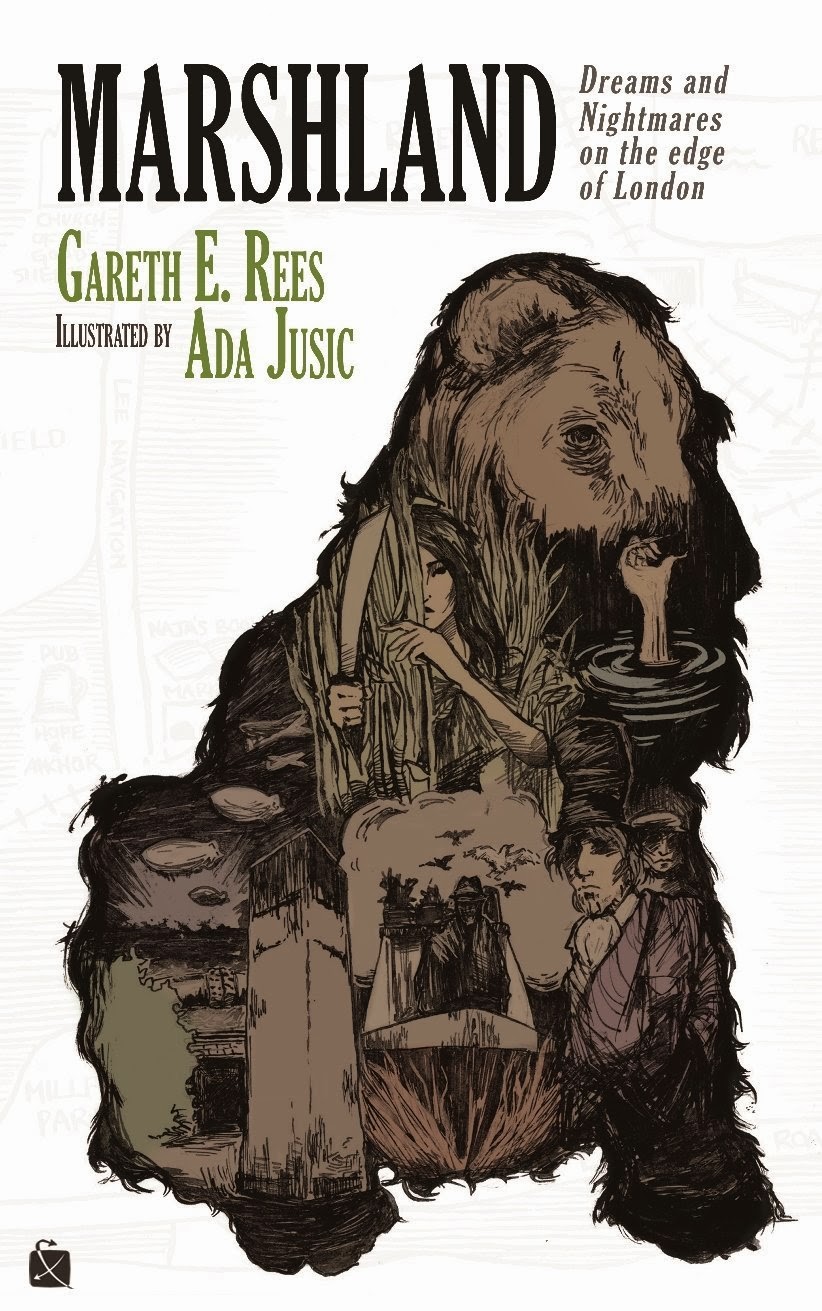
Review: Marshland, by Gareth E. Rees

This book, written by Gareth E. Rees and illustrated by Ada Jusic, surprised me greatly. I was initially interested in it because, on the surface, it tells stories of and about the area around the Lea basin; and I grew up a short walk from the River Lea. I was therefore looking to reminisce, perhaps to learn a little more of the area's history.

However, Marshland, Dreams and Nightmares on the Edge of London is so much more than that.

I was not prepared for its broad scope. Part memoir, part historical document, part political commentary, part strange story collection... it works on so many levels. It even has a humorous aspect, with a very funny sequence involving social media, which made me laugh out loud. Although it's all of these things and more, Rees has pulled it all together remarkably well, and it is a thoroughly satisfying read.

Our protagonist wanders the Hackney marshes and the banks of the River Lea with his dog Hendrix. He reflects upon his life, the geography of the area, its history, and his own imagination. In this unique landscape he muses over the legacy of the London Olympics, the inland waterways, the disused filter beds, the fascinating story of Whipple and Hazlehurst, and much more. The reader is taken on a number of journeys where the past meets the present; and where they collide, ghosts are encountered and strangeness abounds.

These ghosts initially take the form of engineers from the Victorian era, haplessly time-travelling and way out of their depth, in The Most Peculiar Vanishing of Messrs Whipple & Hazlehurst. Rees expertly uses these characters from history to highlight the changes in the area both physically and socially. In The Ghost Factory, occupants of a trendy development built on the marshes find themselves transforming into the workers from a demolished factory. Marsh Meat sees Albie meeting a bear... but does the bear meet Albie? Of particular interest to me are the ongoing sightings of creatures in and on the banks of the Lea, as these reports formed part of my own childhood. We even visit the area as post-apocalyptic landscape in Naja's Ark, a fascinating prediction of the near-future; and in Endgames, the switch to the Gregorian calendar is pondered: 'The day Parliament stole time, things began to go wrong on the marshes.'

The illustrations work very well, even in the Kindle version which I purchased, adding another dimension to the book. Indeed, included is The Raving Dead, a stand-alone graphic tale involving zombies rising up from the Lea and haunting the marshes. What more could you want?

Marshland will make you look at your own environment in a different light. It combines fact with fiction, history with horror, temples with time travel. Rich pickings! I enjoyed the ride and I can't wait to read more from Gareth E. Rees.

Wednesday, 29 January 2014

Review: Little Visible Delight, by S.P. Miskowski & Kate Jonez

Obsession
1. An idea or image that repeatedly intrudes upon the mind of a person against his will and is usually distressing.
2. The action of any influence, notion, or 'fixed idea', which persistently assails or vexes, esp. so as to decompose the mind.
3. The hostile action of the devil or an evil spirit besetting any one; actuation by the devil or an evil spirit from without; the fact of being thus beset or actuated.


When I found out that Little Visible Delight, the anthology of dark fiction by S.P. Miskowski and Kate Jonez, was themed along the lines of 'obsession', I felt compelled to get out my copy of the Compact Oxford English Dictionary. Each definition seemed scarier than the one before. It was a good omen.

There's nothing quite as inviting as a collection of dark fiction, especially with every story being new to me; and every page of this publication is to be savoured, consisting of edgy, unnerving tales of subtle strangeness. Proceedings kick off with The Receiver of Tales, by Lynda E. Rucker, in which Aisha recalls her intimacy with Ruben, and of how he had been usurped by people's stories; and of how it ruined him. Has this curse been transferred to her? It seems so, as she carves precious words all over her body. Is she stronger than he, or will she take the easy way out? She embarks upon a dreamlike journey, and at its conclusion, Aisha realises she cannot live without the very obsession she railed against.

Preoccupation with the fountain of youth and the ruthless pursuit of immortality is tackled in the complex Needs Must When the Devil Drives, by Cory J. Herndon. It seems we must be careful what we wish for, and be grateful for being a long time dead! Next up Kate Jonez provides A Thousand Stitches. Laura Beatty finds herself at Malley's Dry Cleaners, a down-at-heel establishment which she hopes is a stepping-stone to the exciting life just around the corner in New York. She repairs wedding dresses with Judy, a worker who seemingly has a murky past with the firm. When conditions and pay are changed for the worse, Laura Beatty faces the fact she may never be able to achieve her dream of escape; yet a chance is given and taken both immediately and gratefully. Once she is safely in New York, however, the reader has cause to question both her motives, her methods and even her identity.

Johhny Worthen's intriguing tale The Point, set in the dark bunker of the mind, tackles death and Armageddon, leading on to Calligraphy, by James Everington. Blake rises one morning, not as a beetle, nor even to be arrested, but to find 'elegant, cursive writing' all over his face. He is, however, unable to decipher the meaning of the words. Forced to forsake his preferred seclusion in order to seek some kind of explanation, a neighbour leads him to an unfamiliar church, in what has become an unfamiliar world; in front of the congregation, the priest reads the words on his face. Does this bring enlightenment, or just the opposite? A typically compelling story by this author.

This Many, by S.P. Miskowski, explores the world of the competitive parent. Stay-at-home mother Lorrie dreams of the perfect fairy dress for her daughter Frances, and forces her to don it for her birthday party: '"Mom made it so I have to wear it," Frances said, and rolled her eyes.' During this extravaganza, an extra adult appears and causes much confusion after disappearing somewhere within the house. A search reveals nothing, but the contact between the sinister intruder and Frances has caused something to change, so that next year's party may not be looked forward to quite so enthusiastically... Miskowski deftly exposes the cracks present behind the facade of the perfect family, leaving the reader to wait for the inevitable collapse.  

JP, by Brent Michael Kelley, explores a child's seemingly innocent obsession with a pet which has died; and of how a strong desire not to be separated ends in something gruesome. Deceptively simple, this story is not for the fainthearted, and is as close to conventional 'horror' as this collection gets. Black Eyes Broken, by Mercedes Yardley, is the sad tale of Natalia, who has the unfortunate knack of destroying everything she loves. Her relationships inevitably end in tragedy, and this leads to her withdrawal from the world. Worse is to come, however, as she thinks of the future.

This fine anthology is topped off by Bears: a Fairy Tale of 1958, by Steve Duffy. This is a finely-wrought take on Goldilocks and the Three Bears, documenting the Bear family's attempt to assimilate into late-1950s society, but suffering from discrimination, heartache and practical problems at every turn. Tongue-in-cheek it may be but it still packs a satisfying punch.

There is not a weak story here; and, add to this the excellent design and presentation of the Kindle version I bought, means I would recommend this wonderful collection to anyone who enjoys short stories.

Sunday, 19 January 2014

Dying Embers available for pre-order

I'm very pleased to announce that Dying Embers, my first collection of strange adventures, is now available for pre-order direct from Satalyte Publishing. All you have to do is send an e-mail to sales@satalyte.com.au with your request and there you go! It will give them an idea of the demand in advance of publication... and you'll be first in the queue.


“My mind had created a monster in the next terrace…”


Welcome to the world hidden behind the everyday. These stories of urban strangeness explore what goes on within the dying embers of the fire, once the heat has almost gone.

An historic building holds the key to a terrible secret from Letherby's youth. A passenger on an international flight finds out that he is not master of his own destiny – finding out who is, though, is quite another matter. Rural Australia proves less welcoming than Preston had hoped, forcing him to confront the guilt from his past. Pocock witnesses something calamitous on the river bank which changes the course of his life. The alien landscape of a network of warehouses provides the background to a remarkable transformation. An ill-fated property search leads first to admission, then to a strange form of retribution, and ultimately to a terrifying reunion.

“A fascinating and eclectic collection of strange adventures…”
James Everington, author of Falling Over.

“These are powerful, energetically written tales that are some of the finest I’ve read in the genre of dark fiction. The language is wonderfully imaginative and instantly thrusts the reader into the realms of slowly revealed decay. A must-read!”
Paul Hodge, Freaky Folk Tales


Check out the full list of books coming up from Satalyte here. Many genres are represented, so there is bound to be something for everyone. By the way, the website for Dying Embers is at martincosby.com so have a look if you like. I will let you all know as soon as I have a publication date.

Monday, 6 January 2014

Farewell Elizabeth Jane Howard

I was born in Kensington. My father was a composer. My mother came from a rich home, and was, I believe, incurably romantic. She married my father, despite the half-hearted protestations of her family, who felt that to marry a musician was very nearly as bad as to marry into trade, and much less secure.

My old copy of The Beautiful Visit (1950), Howard's first novel
So begins chapter one of The Beautiful Visit, Elizabeth Jane Howard's first novel, and the first example of her writing I had encountered; many years ago. It soon became one of my favourite novels. Enchanting, sensitive and beautifully written, it tells of a magical experience in a young girl's life, the mood of which can never be regained. Despite the delicate, elegant prose, it is also powerful, quite an achievement for a writer so young (she was in her twenties at the time). The book is dedicated 'To Robert Aickman', and it was some time before I noticed this, linking it to the author of Ringing the Changes and The Hospice I had enjoyed many more years previously. Intrigued, I bought a copy of her excellent autobiography Slipstream, and I began to discover what a strange relationship the two had. As my interest in Aickman deepened, it became clear how much she may have affected his writing.

Slipstream, her excellent autobiography
The Beautiful Visit displays a sense of mystery, a lightness of touch – even, yes, of strangeness – which could in fact have influenced Aickman. They first met when she approached him with the complete manuscript of The Beautiful Visit as he was at the time a literary agent, and an experienced writer, though only in journals and of reviews. He advised her and helped her revise her work, and was influential in getting it published. It was an immediate success, winning the John Llewellyn Rhys Memorial Prize and selling well.

The Tartarus edition of Three Miles Up, Howard's own collection of strange stories
It was only after this that Aickman began writing his own fiction. I've heard suggested that he was rather jealous of Howard's admiration of L.T.C. Rolt's supernatural stories, therefore setting out to outdo his fellow Inland Waterways founder by penning his own. (If this is true, in the long term he was certainly successful; however, Sleep No More, Rolt's collection of short stories, is well worth reading in its own right.) His problems began when he struggled to get his own stories published. It was perhaps a blow to his ego when he could only achieve this by a joint venture with Howard, insisted upon by the publisher to ensure sales; which became We Are For the Dark. Certainly Three Miles Up, one of Howard's three stories in the collection, could be said to be Aickmanesque; however, it was written before such a term could be applied. It's certainly one of the most finely-wrought and enigmatic of short stories. Howard of course went on to achieve the kind of critical and commercial success Aickman could only dream of, and indeed he went searching for something similar by dallying with the American market later in life. He barely succeeded (his works were rarely reprinted, and his stature has grown, in the main, since his death). Howard was to spurn him; yet Aickman's fondness for her continued throughout his life. He even asked to see her on his death bed, a request which it is said she declined.

I had a dream some years ago that I bumped into the ageing but still beautiful Elizabeth Jane Howard at a party, and she shared with me and me alone some confidential snippets about her tempestuous relationship with Robert Aickman so many years before. Until a few days ago, I was hopeful this unlikely event may somehow occur.

Farewell Elizabeth Jane Howard. 

Friday, 27 December 2013

More books of 2013

Following on from my blog post earlier this month, here are some more of my books of 2013. There really have been so many great short story collections new to me this year!

Once again, in no particular order:

Surely one of the anthologies of the year; S.P. Miskowski and Kate Jonez's
superb Little Visible Delight. Review soon
Surprise of the year! Gareth E. Rees's weird
psychogeographical study of the Lea basin,
Marshland; Dreams and nightmares on the Edge of London
Is it a novel, or a collection of short stories?
It's certainly strange and compelling. Keith Ridgway's Hawthorn & Child
John Langan's expansive and spectacular
The Wide Carnivorous Sky
New from Reggie Oliver; Flowers of the Sea
Scream of Angels; more Victorian horror from David Haynes
Be drawn into Mark Fuller Dillon's world if you dare;
the stellar In a Season of Dead Weather
Keep an eye out, I will post reviews of some of these excellent books soon.

Thursday, 19 December 2013

My year that was

Time to reflect briefly on 2013.

I haven't been blogging much recently... as I have actually been writing a lot, and also doing the final edits on Dying Embers. However, more about that later. In so many ways it's been a big year for me; I have had three short stories see the light of day, and my first collection of short stories has been accepted by a publisher. I have also written more consistently than at any other time of my life.

Well, back to Jan 2013. In Transit and Unit 6 had just been published in Darker Times, my very first success with fiction (I had for some years written the occasional non-fiction feature for magazines). This encouraged me so much. I had never before thought that anyone else would want to read any fiction I had written, yet I got a lot of positive feedback. At the end of 2012, I had also started my foray into social media, and I was concentrating on building that up a bit too.

I must add here that I have had some good support from some great writers through the year; particularly James Everington, PJ Hodge, KJ Blackwood, Maria Savva, Dionne Lister and Jess Coleman, among others. A big thanks to everyone. Exciting times for me, then, but early on I really was not convinced I would ever be able to put together enough stories for a whole collection. All of my early tales were autobiographical (I did work in Unit 6, my grandparents did live in a big old terrace, I do run around the coast at Currarong... I could go on, but you might have to buy the book when it's out!). The problem was, I had no idea whether I would be able to write anything that was not directly from my own experience. Come to think of it, I still don't, but that's another story.

As the writing lark was all so new to me, I had to find out how exactly I could fit it into my life. I look after our two children while my wife works, so it's a matter of giving myself the opportunity to write. Generally when I have dropped the youngsters at school, I make my way to the local shopping centre with my Rolser (the Ferrari of shopping trolleys), and on the way I stop at one of two cafés. I have found that if I try to work at home, though I have a perfectly good office, I am distracted by the washing, tidying up, changing the beds... you name it. So I'm much better at spending a couple of hours typing madly in Café 169 or Café Heliz, where they know my writerly ways and put up with me. Then it's to the shops – I always shop daily, and do my best to avoid the supermarkets – and home between 12 and 1. Then, most days, it's time for a run, and often I become inspired during said activity; so it's home, late lunch while listening to the Archers podcast, and off to get the children. Take them to a playground, or swimming etc, and out comes my A6 Moleskin and I jot down the ideas that visited me during my run while they are otherwise occupied.

My Rolser, the Ferrari of shopping
trolleys, in Café Heliz
My favourite spot in Café 169
So, having sorted my routine (apart from school holidays, when everything goes pear shaped!) the stories came to me well enough during the year, and by November I had the 10 I was aiming for. It was during the process of editing and formatting for the self-publishing process that I heard about Satalyte Publishing, based in Melbourne. Almost as an afterthought, I pasted everything into a Word document, and sent it off. I was delighted to hear back from the great Stephen Ormsby almost straight away that he may be interested in publishing it for me. Great news! Soon contracts were signed, and terms agreed. Right now, I am working on final edits with Stephen, who I must say has provided some fascinating insights and subtle alterations to some of my tales which have improved them no end. So far, I couldn't recommend both Satalyte and the process too highly.

By the way, I have spent some time setting up a website for my writing, over at martincosby.com, so have a look at that when you have a moment.

To top off the year perfectly; I hope he doesn't mind me announcing it, but James Everington, author of two great collections of weird fiction (The Other Room, and Falling Over) and a stunning novella (The Shelter) has agreed to write the foreword for my own collection, Dying Embers. Cheers James!

Monday, 2 December 2013

Books I have read in 2013

Well, it's that time of year again. I was looking back over the blog, from twelve months ago, thinking about my best reads of last year; and, if anything, 2013 has been even better!

I've certainly noticed a resurgence in short story collections, which is indeed heartening. In fact there have been so many new collections out recently that I have barely been able to keep up. I will get around to some more reviews soon, but in the meantime I thought I would share 12 of my favourite reads of the year with you. (As usual, just books that were new to me this year; not necessarily newly-published.)

In no particular order, here we go:

The Moon Will Look Strange, the great new collection from Lynda E. Rucker.
I haven't finished this one yet, but so far so strange; News From Unknown Countries, by Tim Lees.
Fabulous new collection of strange stories by James Everington; Falling Over. My review here.
Brand new and a must-read; Ill at Ease II. Review soon.
Strangeness indeed from Scott Langrel. The Grass Monkey and Other Dark Tales.

Jason A. Wyckoff's brilliant debut; Black Horse and Other Strange Stories. My review here.

John Metcalfe's timelessly eerie collection, Nightmare Jack.
The Collection and Other Dark Tales by Tracy L. Carbone. Terribly good; review soon.

PJ Hodge's Poe-esque collection of freaky folk tales; Ghosts and Other Supernatural Guests. My review here.

Classic ghost stories from Eleanor Scott; Randall's Round.
Great new name on the scene; Lauren James's The Side Effects of the Medication.
Satisfyingly strange, in fact my novella of the year; Trent Zelazny's People Person.

Well, that's a great mixture of new collections and classics. I've read many more great books this year, so look out for subsequent lists. In the meantime, I'll try to get some more reviews done. Oh, and I nearly forgot; I also have to do the edits for Dying Embers, my own collection coming out next year from Satalyte Publishing. Wish me luck!