Dying Embers out now

Dying Embers out now

Saturday, 15 June 2013

Progress with Dying Embers

I have now completed seven short stories for my inaugural collection, tentatively titled Dying Embers. I realise I haven't mentioned this lately, as progress has been painfully slow. Even the stories which have been published previously have been revamped. In fact every time I re-read them I change something! Does anyone else have this problem? Anyway, my feeling is I need around 10 in total, which is OK as I have five more in progress; but at this rate it will be another few months before I can even think about finalising things. Part of the trouble is that I have not been writing for long (not fiction at least) so I don't have any kind of 'treasure chest' of previously written stuff. Also, the layout and general look of the book is concerning me. As a graphic designer, I'm used to having complete control over these things, and with e-books these aspects are amorphous to say the least. The cover is fine, but I want the typography within to work well too. I have experimented with PressBooks, and that seems to work very well. I have entered my text into separate "chapters" which affords good flexibility. It's free, simple to use, and I would recommend it to anyone putting a book together.


Here are the stories I have completed so far:

The Next Terrace
The past collides with the present; childhood bonds are first stretched to the limit then broken in this tale influenced by Dante's Inferno.

Playing Tag
An historic building holds the key to a terrible secret from Letherby's youth. Why is he drawn so powerfully to its mysterious Pavilion?

The Source of the Lea
Pocock witnesses something on the river bank which changes the course of his life. Did it really lead to him discovering the true source of the Lea?

In Transit
A passenger on an international flight finds he is most certainly not master of his own destiny. Finding out who is, though, is quite another matter!

Necessary Procedure
An ill-fated property search leads firstly to admission, then a strange form of retribution; and, ultimately, reunion.

Unit 6
The alien landscape of a network of warehouses provides the background to a remarkable transformation. Or does it?

Abraham's Bosom
A remote coastal walk still echoes with a tragic event from long ago, charting an individual's gradual descent into some kind of madness.


Here are the stories I'm still working on:

Turning the Cup
The traditional art of tasseography combines with local folklore to resurrect an unwelcome visitor.

Building Bridges
You always wanted a left-field story about dinosaurs! Well, I hope you did anyway.

Fingerprinting
Rural Australia proves to be less welcoming than Preston had hoped ...
 
The Key
An impulse purchase on eBay has an uncanny effect, and proves more trouble than it's worth.

Burnt Close
The exploration of a newly-built housing estate changes the course of some young lives.


Hopefully it won't be too many months until it's all done and dusted. I'll keep you informed!

Wednesday, 12 June 2013

Review: Rope Trick by Mark P. Henderson

Rope Trick: Thirteen Strange Tales was published a few years ago, by Ash-Tree Press, and came from an author not previously known for fiction. I was tempted to try this collection after hearing the short story Rope Trick itself being described as 'Aickmanesque'; and, having included this tale in my top ten stories I have read so far this year, I decided to re-read the whole book.


These are elegantly written, genuinely creepy stories in modern settings. As the author himself says in his introduction, there is '... no hint of sinister history, not a creaking door or tomb or mysterious figure in sight, no threat of mortal extinction, and unbroken holiday weather throughout'.  

An Incident in Drereton kicks everything off, and sets the tone. In a mundane English market town, retiree Tom experiences what seems like a strange vision from the past, which, despite its brevity, affects him deeply. He unearths an incident from the past, and, rather than clearing things up, it poses a more significant question. Crooker is a fascinating blend of folk tales, pieced together to create a compelling story with an authentic sense of impending doom. It is written in a different style to the other tales in this collection, and mixes things up straight away. By way of contrast, East Norham is more of a ghost story in the usual sense. Tony Lomax is some kind of psychic investigator, and is called upon to investigate the strange happenings in a house rented by some friends. It would seem to be a case of poltergeists; and, as the story twists and turns, the past collides with the present in a most unpleasant way, and winds up to a satisfyingly ambiguous conclusion.

The breadth of this collection, and the author's skill, is highlighted by the next tale, De Profundis. It is quite unlike its predecessors. Set in some arid outback desert, a mute, pregnant woman appears from the heat haze, and farmer MacGregor takes it upon himself to look after her. However, things do not go to plan; in fact, things go in entirely the opposite direction. I won't spoil the shocking end of this story, but suffice to say it is not ambiguous at all!

Next up is Rope Trip itself. A group of friends suffer a breakdown of the mechanical kind while on a driving holiday, and are forced to find solace in a large, solitary house. Were they somehow expected? Their travails when attempting to leave, and subsequent strange disappearances, add up to a supremely atmospheric tale which wrong-foots the reader at every turn. The title of The Well Dresser is a play on words that does not perhaps do the story justice. This is another tale which seems to draw from local legend or folk tale, and draws the reader into the village politics and prejudices of a previous age. Do you believe in the old wives' tales?

Period Instruments is a perfectly-formed tale of poignant memories, and a highlight of this collection. The protagonist is recalling a visit to The William Marshall Collection of Antique Musical Instruments, in the backstreets of an idyllic seaside town, when he was 'approaching his fourteenth birthday'. His magical encounters with the various instruments, especially the clavichord, is both elegantly written and thought-provoking; and William Marshall himself is touchingly portrayed. Following this, the tone is lightened somewhat by Disappearing Act, which is a brief reminiscence with a very apt title; but I won't spoil the story for you.

Return Ticket is an intriguing tale of a journey David takes on public transport. He finds an old copy of a novel on the seat beside him on a train, which he subsequently finds has rather more significance than he imagines. Handicapped by only having the haziest recollection of his past, he discovers more than he is comfortable with; and the reader is taken along for the rollercoaster ride. I must admit, I'd very much like to see what else the Cobham Circulating Library has for loan!

Writing with a regional accent is always hard to pull off, and can make or break a story; in Ticking, the author has portrayed Scottish well, adding to the atmosphere. Peter and Jock are looking to make a delivery from their articulated lorry on a foggy November night, but get lost and are thwarted by a narrow lane. They seek shelter in what seems to be some kind of monastery, with the sound of ticking reverberating throughout, despite there being no clocks. Their subsequent discovery about the area, and Jock's ultimate fate, make them question their recollection of the mysterious events.

I'm not usually one for werewolf tales, but Rome Will Rise Again is the best I've read for some time, combining jealousy and doomed relationships with a sense of foreboding and, ultimately, horror. The clashes between Ilia and Lucrezia add a convincing psychological interest. Genius Loci is the touching tale of a young boy who grows up to learn of the protective spirit resident within Nathan's Wood. 'Everything around him, the blade of grass and the beetle crawling along it, the rowan and birch, with their perfect branches and perfect leaves, the far hills and the creamy white cumulus, glowed with their own inner light.' Unwisely, in later life, he takes this wife to visit the wood, and her cynical view of the place brings about a terrible retribution. This is an evocative tale of the power existing in the depths of the English countryside; and perhaps the English psyche.

Rope Trick: Thirteen Strange Tales concludes with What Became of April, which is novella length. It deals with the disappearance, lasting three weeks, of a girl on her 19th birthday. Her changed demeanor upon return, being terrified of any modern aspect of life, suggests a kind of transfer has taken place between two time frames. It's an ambitious end to the book, and gives food for thought. My only reservation is that it could have been more concise; some of the focus present in the other stories was not present, and I found myself feeling it lost direction a bit. For me this was the difference between four and five stars for this excellent collection.

Overall, this is a beautifully written set of strange stories that deserves to be better known. I have no idea if Mark P. Henderson will write more in this vein; but I very much hope so.

Saturday, 1 June 2013

Top ten short stories of the year so far

I couldn't let short story month slip by without mention. (OK, I admit I knew nothing about it until this morning ... and, technically, it's not May any more ... but never mind that.) So I thought I should put together my top ten short stories of the year so far to mark the occasion. That is, not necessarily stories that were written or published this year, but ones that were new to me.
It's been an excellent year so far, and I've enjoyed so many short stories. So, in no particular order, here's my top ten.

1. Bones in the Meadow by Tim Jeffreys. From Bones in the Meadow and other weird tales.
I first read this in the anthology What Fears Become, before buying the author's collection itself, which I have not yet read. I was sucked into this strange tale, captured by its sense of unease. Jim is a youth embarking on a camping trip with two traveling companions, Ste and Kelvin. It seems, as they make the transition by train from normality to an abstract, fog-bound landscape, that Jim is being coerced by his more worldly-wise friends. '"Guys, I think the town is that way." "Town!" said Ste with a laugh. "We're not going to town, Jim. We came to get away from everything, didn't we? We came here to get lost."' However, once Ste finds a skull in a nearby field, being lost loses some of its attraction; and it seems they are just as helpless as he is. Can Jim resist the lure of the mysterious girl tempting him to confront his deepest fears? I found this to be one of those stories I'm compelled to go back and read again, and I am eagerly anticipating the rest of Tim's collection.

2. Skirmish by David Longhorn. From The Ptolemaic System.
I have previously mentioned that I am a fan of David's Supernatural Tales short story collections, and that I enjoyed his collection The Ptolemaic System. This tale of morale-building manoeuvres "in a wooded valley in Northumberland on a drizzly August weekend" explores what happens when office workers on a team-building exercise collide with the past. Bill and Tracy, straying from the war games they have no interest in, become involved in a deadly hunt. Or do they? The mixture of the banal and the fantastic, and the ancient and modern, made this story stand out for me; and the ending intrigues.

3. The Remover of Obstacles by James Brogden. From Urban Occult.
Terry Grainger has all sorts of bother picking up his car after obtaining an MoT. He is led on a less than merry chase from one seedy establishment to the next, in a spiral of confusion, through a bleak industrial landscape. His increasing disorientation and ultimate 'priority fast-tracked' fate combine to create a Kafka-esque roller-coaster ride which I found to be quite compelling.

4. Elevator by Adam Millard. From Urban Occult.
Also from Urban Occult, this is just my kind of tale. The setting, a bleak high-rise block of flats within a concrete wasteland, rings so true to me; and Sean is the perfect anti-hero. His chance meeting on the stairs sets the scene apparently to go in one direction, but things get turned around in the most shocking way. Elevator is full of brooding, threatening atmosphere, but the real danger approaches from an unexpected source. The scene involving Dennis and his mother in their insalubrious flat will stay with me for a long time, and more than makes up for the ending; which I found perhaps a tad conventional.

5. Inside/Out by Nicholas Royle. From House of Fear.
I'm a big fan of Nicholas Royle, ever since I read his remarkable tale of urban alienation Archway many years back. House of Fear is an excellent anthology, and this story is one of the best of a good bunch. In this deceptively complex tale, Japanese sensibilities collide with a prosaic north London setting, creating an austere atmosphere. The house, with its conflicting entrances and labyrinthine layout, serves as a great analogy for the confusion within the protagonist's mind. This story reminded me a little of Laura by Robert Aickman. Which is something of a recommendation!

6. Mirages in the Badlands by James Everington. From Sanitarium #008.
It's always interesting to read a good writer's interpretation of an unfamiliar genre. I suppose it could be said that this is a zombie story; which would not normally interest me. However, I soon found out that foremost it is a James Everington story. That is, written from his usual slightly skewed perspective, and therefore gripping from beginning to end. The relationship between the unfortunate Chavez and his two captors is convincingly told, and the change of perspective at the end will make you think. The best zombie story I have come across by far.

7. The Engineer by David Haynes. From Ballet of the Bones.
The Engineer is a short story from Ballet of the Bones, part of David Haynes's collection of Victorian-style penny dreadfuls, including Mask of the Macabre and Seance of the Souls. The titular engineer's career develops from repairing sewing machines to something decidedly macabre, prompted by the unexpected visit from a badly injured officer of the Crimean war. The engineer's quest for perfection leads to murder, and subsequently to his unsuspecting part in a grisly sideshow. The story is told with authentic atmosphere and an impressive sense of impending doom. Enter at your own risk.

8. A Tale of Chirbury by PJ Hodge. From the Darker Times Anthology Vol 3.
For me, PJ Hodge's blog, Freaky Folk Tales, has been one of the finds of the year thus far. His thoroughly researched and well-written (in the style of MR James) accounts of local folklore from around the British Isles are quite compelling. His output is prodigious, and certainly deserves to be compiled in print; so I was pleased to see A Tale of Chirbury included in the Darker Times Anthology Vol 3, following on from my own story, Abraham's Bosom. I won't spoil the story, but this tale of supernatural happenings in the little village of Chirbury, and its gateway to the past, will intrigue you; and you'll soom be a regular visitor to the Freaky Folk Tales blog, just like me! 

9. Three Degrees Over by Brian Aldiss. From Dark Fantasies.
This is an oldie but a goodie, from the anthology Dark Fantasies, which is long out of print but well worth looking out for; I rediscovered it on my bookshelf recently. Brian Aldiss is of course a very accomplished writer, and Three Degrees Over is something of a tour de force among the many strange stories I have read. Alice Maynard is returning by 'plane from the US to her settled and mundane life among the spires of Oxford. However, on the flight, she finds herself seated next to Felicity Paiva, an American who somehow imposes herself upon Alice's hospitality. Her baffling effect upon Alice's previously reserved husband Harold, with its heavy undercurrents of passion, sets the scene for a literally fantastic conclusion which has to be read to be believed.  

10. Rope Trick by Mark P. Henderson. From Rope Trick: Thirteen Strange Tales.
This is a great story, and has been called 'Aickmanesque', which is what attracted me to Mark P. Henderson's work in the first place. Well, I must say it is not in fact 'Aickmanesque'; however, it does not need to be. It stands very well in its own right. A group of friends suffer a breakdown of the mechanical kind while on a driving holiday, and are forced to find solace in a large, solitary house. Were they somehow expected? Their travails when attempting to leave, and subsequent strange disappearances, add up to a supremely atmospheric tale which wrong-foots the reader at every turn (and, most importantly, the ending is great). This is a good example of the author's work, all of which I have enjoyed.

Thursday, 23 May 2013

Perfect penny dreadfuls

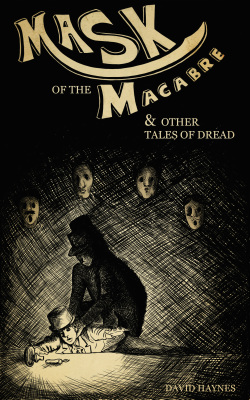
I've been immersed (or should I say shrouded) in Victorian gothic recently. I was tempted to try Mask of the Macabre, a collection of four short stories by David Haynes, and became hooked. This led me to his second collection of tales, Ballet of the Bones. Just as I was regaining my breath from that one, I found out there was a novella called Seance of the Souls. I must point out that the author has done a very clever thing; it is quite possible to enjoy any of these books individually, in any order ... yet taken together, and in sequence, they tell a story which will keep you on the edge of your reading chair (perhaps your mind?) until the very last page.


Mask of the Macabre sets the scene for your journey to the sordidly time-worn and foggy streets of Victorian London. You will soon wonder at the magician's grisly sleight of hand, and be shocked by the change of scene taking you within the walls of the Bethlem lunatic asylum. Then, the photographer's hideous job will make you wonder at the evil within human nature; depositing you, finally, with the entertainer – looking to expand his gruesome repertoire. If you are not too shell-shocked by now, you are welcome to experience ...


... the Ballet of the Bones! Will you appreciate the hideous displays in The Gallery of Wax? If so, you will be ushered into The Bone House, to experience first hand the bare bones of the gravedigger's existence. You will then meet The Engineer, who will astound you with his baroque, intricate creations, operating with the strange grace of precision; yet somehow quite wrong. And finally, with an impending sense of doom, the Director will prepare you for the final curtain. Good luck!


Perhaps, though, you may not be able to make your escape quite yet. You will be drawn, almost against your will, into the swirling, misty alleyways of the past once more, to experience the Seance of the Souls. With a growing sense of unease, you'll recognise some of the hideous characters from your previous travails.


Beginning with a funeral where Matthew Napier is confronting the loss of his family, you will stumble through bloodstained gutters once more to witness a fortune teller giving him and his sister a bleak reading indeed. Once Matthew's sister is ripped from him too, his despair is complete; and he is vulnerable to the advances of pure evil. This is embodied by members of a spiritualist church, and he is confronted by the past in ways even you, dear reader, could not imagine. Is it magic, or murder? Who can Matthew trust? Amid corpses, skulls and ever-shifting masks, you will not know which way to turn. Be sure to keep your own senses sharp as those around you descend into madness!

Friday, 17 May 2013

Mask of the Macabre and Ballet of the Bones

I have just discovered the work of David Haynes, and have thoroughly enjoyed his two collections of short stories, Mask of the Macabre and Ballet of the Bones.
Firstly I must say I was tempted to try them due to their excellent, quirky covers. As a graphic designer myself, I appreciate the visual side of the equation when it comes to publishing, and these really stand out. Not only are they that bit different, but they suit very well the content and style of the books.


As for the tales themselves, well, I may very well do a review soon (and also of his new novella, Seance of the Souls), but in the meantime I hope Mr Haynes would not mind me reproducing the blurb he has provided on his website:

Mask of the Macabre
Four short tales of Victorian terror, each bound to the other by a chilling  thread. The date is January 10th 1866 and the snow is falling thick on  the blood soaked streets of a murderous London…
Mask of The Macabre: A travelling magician appears with a gruesome show. But what secret does it  hide?
Doctor Harvey: Bethlem lunatic asylum’s newest patient has a story to tell, but how will he tell it to his doctor?
Memento Mori: A photographer is given a mysterious assignment with disturbing consequences.
The New Costume: The entertainer discovers a new string to his bow and gives the finest performance of his career.


Ballet of the Bones
Four short tales of Victorian terror, each bound to the other by a chilling thread. London suffocates under the festering reek of its bursting graveyards.
Ballet of the Bones
: The curtain goes up on the greatest show on earth, but is everything all it seems?
The Bone House
: The grave digger reflects on his morbid life, but what does his future hold?
The Engineer: His creations are beautiful, intricate and for a discerning  palate.
Encore
: The director makes ready for the end of the show.

Sunday, 5 May 2013

Childhood influences and burial sites

One of the main influences for my writing thus far has been my childhood. I recently had the opportunity to revisit the playgrounds of my youth; and, perhaps inevitably, I was taken aback by how different they seemed. 
I set out for a run from my childhood home, across the playing fields and through the Spinney I wrote about in The Source of the Lea and Abraham's Bosom, and on to the Marsh House playgrounds. There used to be an enormous children's adventure area styled after a fort, which was impossibly exciting to me as a child, and now it has become a BMX track. Marsh House still stands alongside, but it's a sad sight now, doors and windows boarded or bricked up. I recall the side of the building being painted in bright colours, back in 1978, when it was transformed into a youth centre. At that time there was a go-kart track there, on some old tennis courts, delineated by piles of car tyres. It was a mecca for youngsters back then, but now it is mainly deserted. It occurred to me that there could be some inspiration for a story here, so I thought I'd take some photos.

This is the painted side of Marsh House, which now looks to be deserted and boarded up
The front of Marsh House
All the ground floor windows are either boarded or bricked up.
I wonder what's inside
This made me think about creepy stories suggesting childhood memories, of which there must be quite a few. Two such tales by Aickman spring to mind, The Same Dog and The Inner Room. The interesting thing to me about using a child (or a younger version of the writer) as the main protagonist is that misunderstandings can be created; the child's view of things can be unreliable, which adds to the mystery. One of my favourite stories along these lines must be The Shelter by James Everington. This is a particularly evocative tale of the vagaries involved in the formative years. The Boy in Green Velvet or Come into My Parlour by Reggie Oliver might fit the bill too.


While I was wandering around reminiscing, I was reminded that the surrounding area, Waulud's Bank, is named after a neolithic burial site. A D-shaped enclosure, it takes the form of a grassy bank through the surrounding woods, down which we used to run, roll, cycle, toboggan ... depending on the weather. I've since found out that a major ley line runs through the middle of the site, stretching from Cornwall to Yarmouth; it also bisects the Avebury stone circles. Apparently there would once have been stones at Waulud's Bank too, but they have long since disappeared. We used to find arrow heads, bits of pottery and so on in the chalky soil there, but we thought nothing of it. In recent years, many very significant finds have taken place there, but with almost no publicity. I could only find one scruffy old sign mentioning anything about it; but I'm sure more people would be interested if the history was more widely known.
I'm also sure there's a story in there somewhere ... History can make for a compelling tale, adding a convincing background to a good story, particularly when ghosts are involved. For proof, have a look at the excellent blog Freaky folk tales, for some evocative MR James-esque delights.

Part of the ancient Waulud's Bank in the foreground, and the three blocks
of flats over the hill. Five Springs is the closer of them 
The only sign I could find with details of this fascinating area

Friday, 3 May 2013

Hitcher and Those bastards in their mansions

I have posted a couple of very well known Simon Armitage poems today; Hitcher and Those bastards in their mansions (both from Book of Matches). Not ghostly, but certainly horrific in a mundane, matter-of-fact way; which is something I strive to achieve in my writing. 


Hitcher must be Armitage's most famous poem. It is simple yet ambiguous; is it a straightforward monologue, or is the speaker remembering himself as he was before being enslaved into working life? The casual violence of it is shockingly effective. 

Hitcher
by Simon Armitage

I'd been tired, under
the weather, but the ansaphone kept screaming.
One more sick-note, mister, and you're finished. Fired.
I thumbed a lift to where the car was parked.
A Vauxhall Astra. It was hired.

I picked him up in Leeds.
He was following the sun to west from east
with just a toothbrush and the good earth for a bed. The truth,
he said, was blowin' in the wind,
or round the next bend.

I let him have it
on the top road out of Harrogate – once
with the head, then six times with the krooklok
in the face – and didn't even swerve.

I dropped it into third
and leant across
to let him out, and saw him in the mirror
bouncing off the kerb, then disappearing down the verge.
We were the same age, give or take a week.
He'd said he liked the breeze

to run its fingers
through his hair. It was twelve noon.
The outlook for the day was moderate to fair.
Stitch that, I remember thinking,
you can walk from there.


Those bastards in their mansions could be seen as a powerful call to arms for the populace. It would seem that the privileged should not persist with complacency; instead they should look out for one who sticks to shadows and carries a gun!

Those bastards in their mansions
by Simon Armitage

Those bastards in their mansions:
to hear them shriek, you'd think 
I'd poisoned the dogs and vaulted the ditches, 
crossed the lawns in stocking feet and threadbare britches, 
forced the door of one of the porches, and lifted 
the gift of fire from the burning torches,

then given heat and light to streets and houses, 
told the people how to ditch their cuffs and shackles, 
armed them with the iron from their wrists and ankles.

Those lords and ladies in their palaces and castles, 
they'd have me sniffed out by their beagles, 
picked at by their eagles, pinned down, grilled 
beneath the sun,  

Me, I stick to the shadows, carry a gun